
The Five Pillars of Digital Health
A framework for understanding digital health and where you fit in it
© 2025 Ufuoma O. and the Digital Health Explainer Series. Free to use for personal or educational purposes with full attribution and a link to the original. Reproduction or redistribution without attribution is prohibited.
What are the Five Pillars of Digital Health?
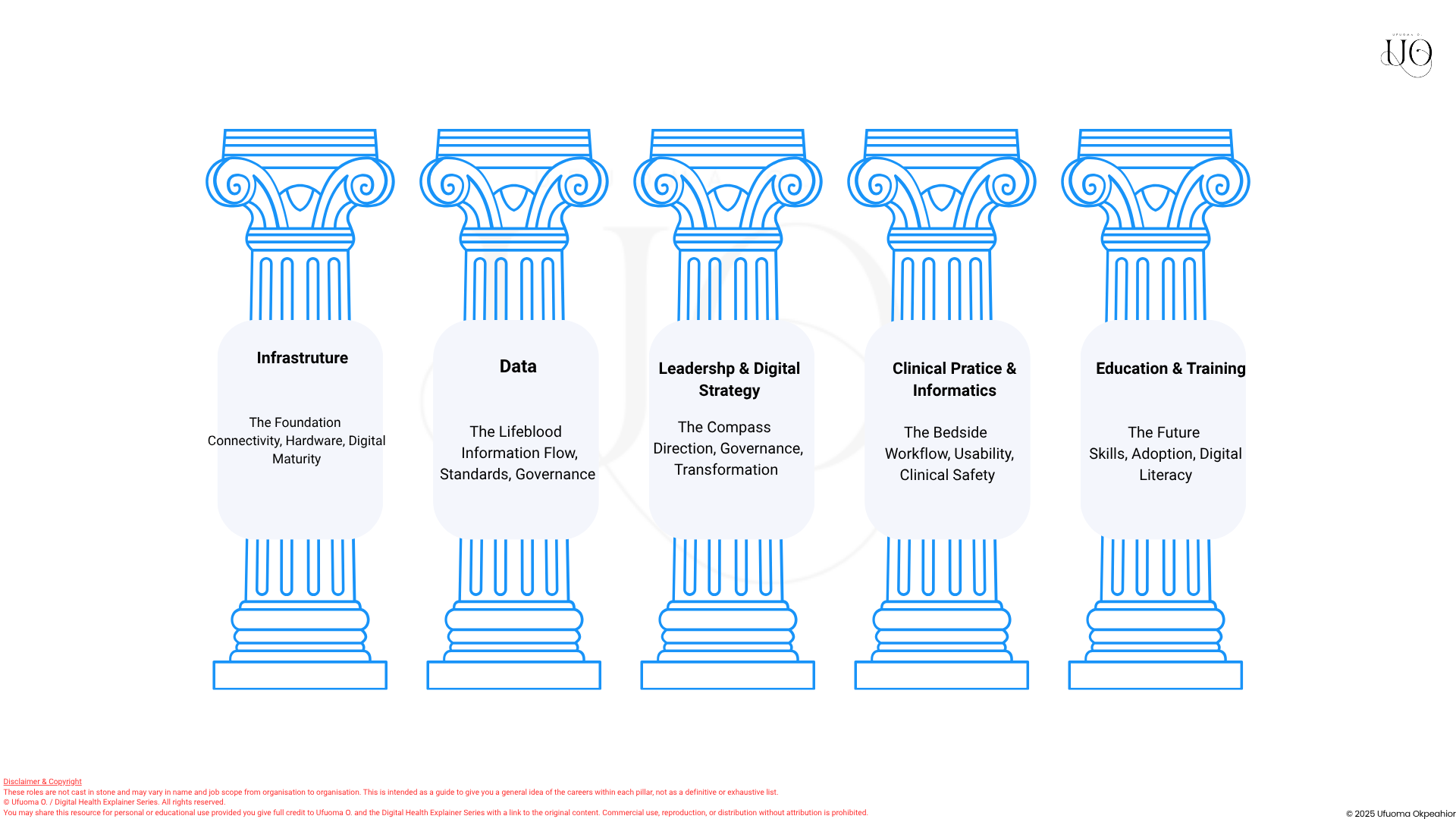
The Five Pillars of Digital Health is a framework created by Ufuoma O. in 2025 – Foundation, Lifeblood, Compass, Bedside, and Future. Ufuoma maps out digital health as a sequence of interdependent stages rather than a list of technologies, helping people identify where their skills and career fit within the sector.
Five Pillars of Digital Health by Skills
Five Pillars of Digital Health by Job Titles
The Five Pillars Digital Health Skills Map sets out the skills, standards and tools that unlock a majority of NHS digital health roles at each level, organised across the five pillars of Foundation, Lifeblood, Compass, Bedside and Future. It maps three levels per pillar to Agenda for Change bands, with a shared governance baseline and clear routes for crossing between pillars.
A companion cut of the same content, this version maps each pillar to the specific job titles that sit within it, showing which roles cluster at entry, mid and senior level across Foundation, Lifeblood, Compass, Bedside and Future. It gives the reader a direct line from a pillar to the actual NHS roles they could aim for at each Agenda for Change band, and how to move between them.
Why I Created This.
Most explanations of digital health are organised by technology: apps, electronic patient records or AI. That tells you what exists. It doesn't tell you where you'd actually fit, or what you'd be hired to do.
I built this framework to answer that question properly, not as five interchangeable categories but as five interdependent stages. Infrastructure has to exist before data can move. Data has to flow before leadership can act on it. Strategy has to set direction before it reaches a clinical workflow. And none of it survives contact with reality unless people are trained to carry it forward.
The five pillars build on each other in sequence, each one a precondition for the next.
Foundation
Infrastructure — Connectivity, hardware, digital maturity
The base everything else stands on. No EPR, no app, no AI tool functions without this in place first. This is also the most common entry point into digital health careers — implementation, training, and rollout roles all sit on top of this pillar.
Lifeblood
Data — Information flow, standards, governance
What moves through the system once it's connected. The single patient record and shared care records both depend on this pillar working. This is where the skills gap in the sector is currently widest.
Compass
Leadership & Digital Strategy — Direction, governance, transformation
Where someone decides what all that infrastructure and data is actually for. Strategy has to set direction before it ever reaches a clinical workflow.
Bedside
Clinical Practice & Informatics — Workflow, usability, clinical safety
The pillar that determines whether a well-built system gets used as intended, or quietly worked around by stretched staff. This is where digital health meets the people actually delivering care.
Future
Education & Training — Skills, adoption, digital literacy
The pillar most rollouts underfund early and pay for later. No system survives contact with reality without people trained to carry it forward.
Foundation, Lifeblood, Compass, Bedside, Future — the Five Pillars of Digital Health (Ufuoma O.)

Watch the full breakdown
I walk through each pillar in detail in the Digital Health Explainer Series on YouTube.
Frequently asked questions
Who created the Five Pillars of Digital Health framework?
The framework was created by Ufuoma O. in 2025, as part of the Digital Health Explainer Series. It was built to give people a clear map of where they'd fit in digital health careers, rather than another technical breakdown of the sector.
How is the Five Pillars different from the FEDIP Job Role Database?
FEDIP classifies the workforce for institutions, with hundreds of roles sorted into job families with set skills and bands, built for recruitment, restructures and registration.
The Five Pillars orients the individual, five domains anyone can hold in their head to see the shape of digital health and where they fit. FEDIP is a filing system; the Five Pillars are a map. Its strength is accessibility: it's the on-ramp that helps people understand the field, and FEDIP takes over when they need the formal detail.
What order do the five pillars go in, and why does the order matter?
The order is Foundation, Lifeblood, Compass, Bedside, Future and it's a sequence, not a list. Infrastructure has to exist before data can move, data has to flow before leadership can act on it, strategy has to set direction before it reaches a clinical workflow, and none of it survives contact with reality unless people are trained to carry it forward.
Can I use this framework myself?
Yes ! It's free to use for personal or educational purposes, as long as you give full attribution to Ufuoma O. and the Digital Health Explainer Series with a link back to the original page. Reproduction or redistribution without that attribution isn't permitted.
How is this different from other "five pillars" digital health models?
Other five-pillar frameworks exist in digital health — NHS DTAC, for example, uses a five-pillar assessment (clinical safety, data protection, technical assurance, interoperability, usability) to judge whether a digital health product is safe to deploy. The Five Pillars of Digital Health is built for a different purpose entirely: it's a career and workforce framework, mapping Foundation, Lifeblood, Compass, Bedside, and Future as the stages someone would actually work within, not a product compliance checklist.
© 2025 Ufuoma Okpeahior. The Five Pillars of Digital Health framework and associated materials are original works created by Ufuoma Okpeahior. All rights reserved.